Author: Paul Stavrides

  • Scanning Your Logbooks

    Hint: Use Your Phone

    I get a number of questions about scanning logs. The most important thing is to avoid procrastination and make some time to get the task done.

    It’s really inexpensive to use a cell phone camera to PDF scanner application. Many modern cell phones have camera resolutions that will yield a greater than 300 DPI scan for an 8 1/2 x 11 in page. Remember to scan everything in your log. It’s a pain to unstaple the 8130 forms, scan and reattach them, but this adds value to the scanned record. In this way you get overhaul information including who overhauled the part and its serial number. Sometimes ADs pertain to certain serial numbered parts. The RAG-AI can keep track of it all.

    Make sure the 8130 or other forms you find in your logbook are scanned in the order they appear in your logs. For best results scan those tags with a separate scan which will form a separate page. It’s best not to have any scan that is bigger than 8 1/2 x 11 inches.

    Another consideration is that we don’t need to do Optical Character Recognition (OCR) on these files. Leave them as image PDFs. The Google AI API in the LogAir.ai system is by far the best OCR and the files will be converted on the fly when using the LogAir.ai system.

    Their are various YouTube videos explaining using your phone to do the scanning. One of my favorite ones is here:

  • German, Spanish?

    I talked with a Baron owner today, he mentioned that his aircraft was at one time operating in Germany and that a portion of his logs were in German. I wondered if this would be a problem for the Google AI we’re depending on for our OCR capabilities at LogAir.ai. As I suspected, the Google Documentation API which does the original OCR of maintenance logs, recognizes Germain as well as Spanish, and about 130 other languages.

    So while we haven’t converted any foreign language logs, it should be entirely possible to do this and print them in English with a simple command.

    We’ll let you know how this goes.

    –paul

  • We Rely on Google AI

    I was doing some coding on Anthropic’d Claude AI the other day. We’re writing code to implement RAG-AI on all the larger AI players.

    After changing some initial prompts, I was comparing the results Claude and the Sonnet 4.5 model we were testing with those from Google’s Notebook LM. I didn’t ask for a comparison but this is what Claude had to say about the Google product:

    Google
    Claude’s (Sonnet 4.5) comment about Googles AI Process. October 2025

    Ok me in a weird space as one AI is complementing another AI. Interesting times we live in.

    –paul

  • Detailed Reports

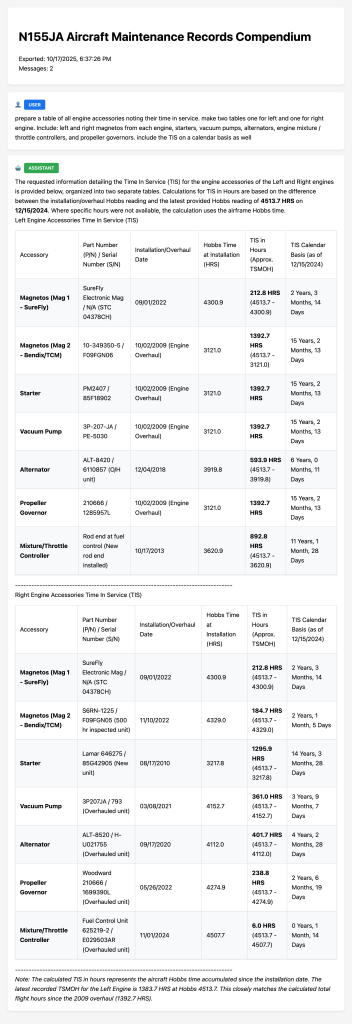
    Once you have finished building the RAG-AI corpus with your log data, we can ask some interesting questions. In this case for a twin engine Baron, we want to know how old the accessories are on the engines.

    Ask yourself how long it would take you to look this information up in your aircraft logs:

  • Keep Flying!

    A Story of Compressions

    Here’s a little exercise on what you can do with RAG-AI and ChatGPT. Total time to get this data in this form was about two minutes.

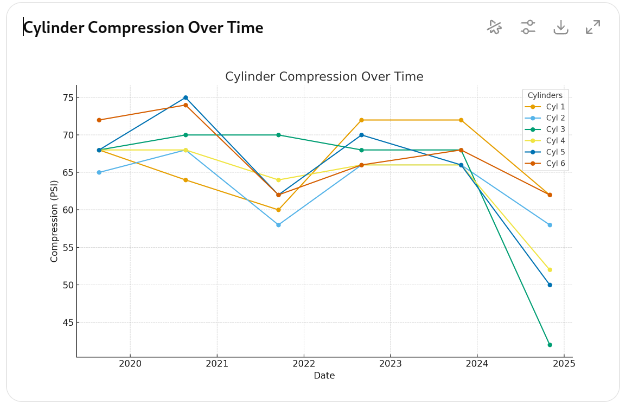
    Let’s ask a simple question of LogAir.ai charged with my maintenance data, “Give me CSV values of the compressions on the right engine over the past six years.”

    I get the values after a few seconds. I copy the CSV values and run them over to ChatGPT and ask it, “Graph these values” I get:

    Wow, that last annual wasn’t so good. Truth be told, we had some major avionics work going on and the Baron had been sitting a lot, not being flown probably a month prior.

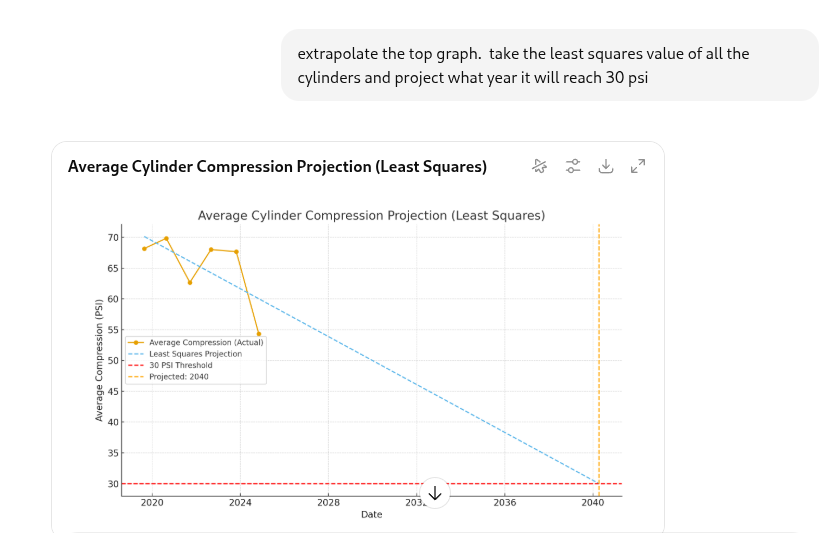
    Ok, wow. Gives me an idea. When will this engine be totally done? I think the lower limit for cylinders is a compression value of 30 PSI. When is that going to happen?

    I suspect the engine will be using so much oil by then, I won’t be able to take any long trips ;). Hopefully, the cam and lifters will hold up as well. I know I’m just playing here. But here’s the output:

    Great in 2040 I’ll be 86. No reason to stop flying!

    –paul

  • It’s a Trap

    Just like Star Wars’ Admiral Ackbar said.

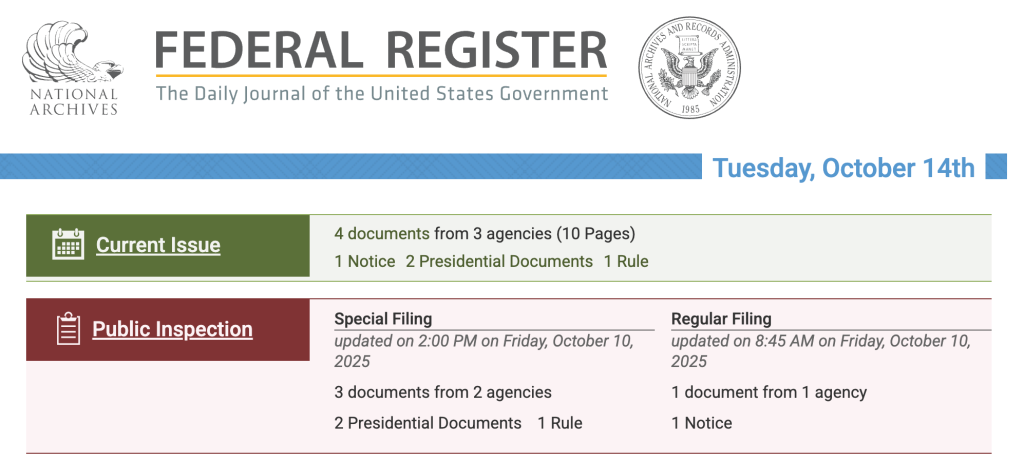
    If you are using the FAA’s Dynamic Regulatory System to look up your aircraft’s airworthiness directives (ADs), did you know you are using a system that’s not an official source?

    FAA documents explicitly state that the DRS is not the “official system of record”. The official record resides with the Office of Primary Responsibility (OPR) for each document according to FAA records management programs.

    The only official source of information about ADs is the Federal Register.

    The LogAir.ai staff have developed software to search the Federal Register for AD data. Only in this way do you know you have the unassailable answer.

    PS: Both the DRS and Federal Register now appear to be offline as far as AD searches go. Ah Gov’t shutdowns.

    PPS: Somebody wisely pointed out that having our app search the canonical Federal Register was as removed as having the FAA’s DRS search the Federal Register. Quite true. Our app will however produce the query used to get the data so you can apply it to the Federal Register yourself if you so desire.

    –paul